Old enough to remember when Ubuntu started, and to have experimented with desktop GNU/Linux a few times before that. Old enough to have been learning about and using Free Code projects for a few years before Indymedia started in 1999.
Yes, this is what you and I have been discussing here.
Pretty much all mobile devices run Linux in some form, except for iThings (a BSD variant) and BorgSoft Surface devices (proprietary god-only-knows-what). Android/Linux and its variants are Linux phone OS. Not sure what kernel Jolla uses, but that’s probably also a Linux OS.
If by “Linux based phone” you mean Mobile GNU/Linux specifically, there are various distros including Ubuntu Touch, Mobian, PureOS. The 2 commercially available devices I know of are Librem5 and PinePhone.
As I mentioned a few posts back, this is not unique to Jolla. Android compatibility layers are relatively easy enough to build, because full API documentation and source code are available for it. AFAIK all Mobile GNU/Linux distros have them available.
As I’ve already pointed out, the change we need doesn’t happen when a critical mass of customers all choose one commercial product. But rather when a critical mass of devices and app developers to choose on OS commons to standardise around.
Yes, many Proof of Concept projects have been launched, including those listed above. But what I’m talking about kickstarting is a standisation effort, with sufficient buy-in to move the needle.
Once my cheap Android is locked down and I cannot use F-Droid any more on it, I will need to make a decision between Fairphone and Jolla. Since the latter is less expensive, I will probably go for that unless an upstart comes along with a better offer. Buyers have a choice, accept status quo or flee.
If I can get something that does not run Deathstar software and does not break the bank. then I will do so. If it takes everybody a bit longer because they need to scratch their bums and think over it, so be it. The Jolla phones have been around a bit and the reviews are such that it ought to do the job. It costs about as much as my cheap Android. Maybe factor in extra for shipping.
If you are in angst. you know where to scratch while you think.
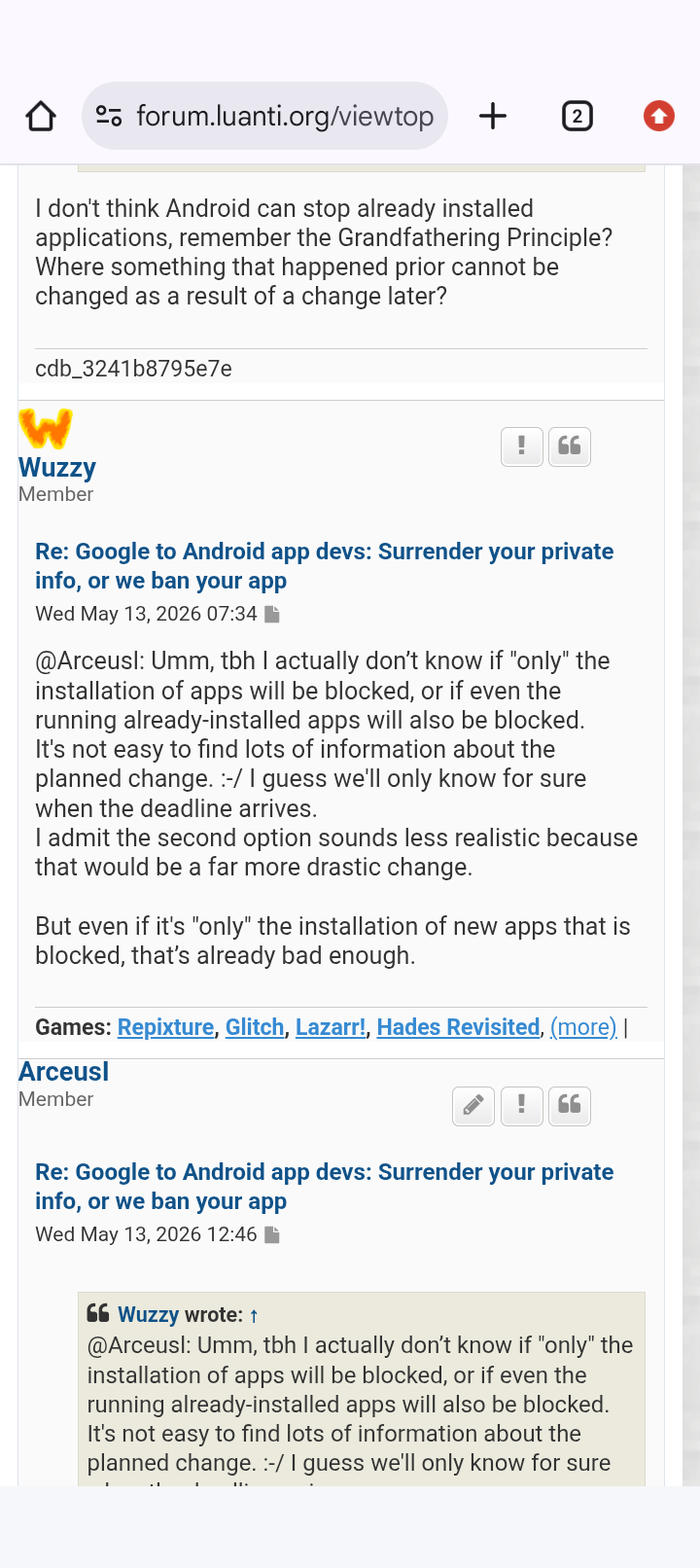
I don’t think Android can prevent an application from running, that would violate freedom of choice & free speech. If Google did try that stunt, there would be lawsuits left and right quickly draining Google of its money, making Developer Verification impractical.
Apple does this, even on desktop. They basically have the very same thing were developers need to register even for apps they distribute outside of Apple’s app stores. macOS then checksums all the binaries against Apple’s services and refuses to run the app if the check fails.
Somehow Apple always pulls that magic trick where they do all that shit without triggering a huge outcry. I think Apple users are just “This is fine” and everyone not using Apple stuff doesn’t care. Microsoft would get grilled for attempting the same stunt (and rightly so).
Though…Now I’m wondering…Would disabling Google Play Services stop Google’s overreach? I know deleting Google Play Services isn’t a good idea on most Androids, but Disabling it is more than doable.
Depends on what apps you use. Example for India, more than 90% of the apps force rely on the services module, and most apps will not even work / launch if it is disabled, including playstore. Some apps do not work when the play scanning is turned off.
But what about Americans? I’m slowly De-Googling further. But still, will Disabling Google Play Services stop Google’s Developer Verification from reaching your device?
Well, Wuzzy isn’t sure what Google’s Developer Verification will explicitly do. He really doesn’t want Google to block applications from running, because then Luanti and various FOSS alternatives will stop running entirely, and F-Droid would struggle hard, even Shizuku would fail at that point.
But still, even just blocking APK installations is bad enough…
Btw, fwiw, running of installed apps may get banned too, maybe not directly, maybe via the devs of the apps. I mean like my sentence above about bank apps and Indian apps. Something similar for sure. & the Luanti response is right, only the internal docs of foogle may tell someone what they intend to do, which are not just externally not available, but restricted and locked behind internal login-walls too.
For sure. Those again may get within the purview of so called hobbyist or something, unless signature remains same.
Btw, the shasum blog, seems like a rabbit’s hole to me. It may get implemented in some negative manner like every single step of foogle.